LCC International University > News and Events > From Miško Darželis to Miško Mokykla: Dovilė Urbanavičienė’s Journey in Education
From Miško Darželis to Miško Mokykla: Dovilė Urbanavičienė’s Journey in Education
2026-08-06
LCC International University > News and Events > From Miško Darželis to Miško Mokykla: Dovilė Urbanavičienė’s Journey in Education
2026-08-06
When LCC last shared the story of Dovilė Urbanavičienė (Class of 2007) in 2019, Miško darželis (Forest Kindergarten) was still a relatively young and unconventional educational initiative in Klaipėda.
Seven years later, much has changed.
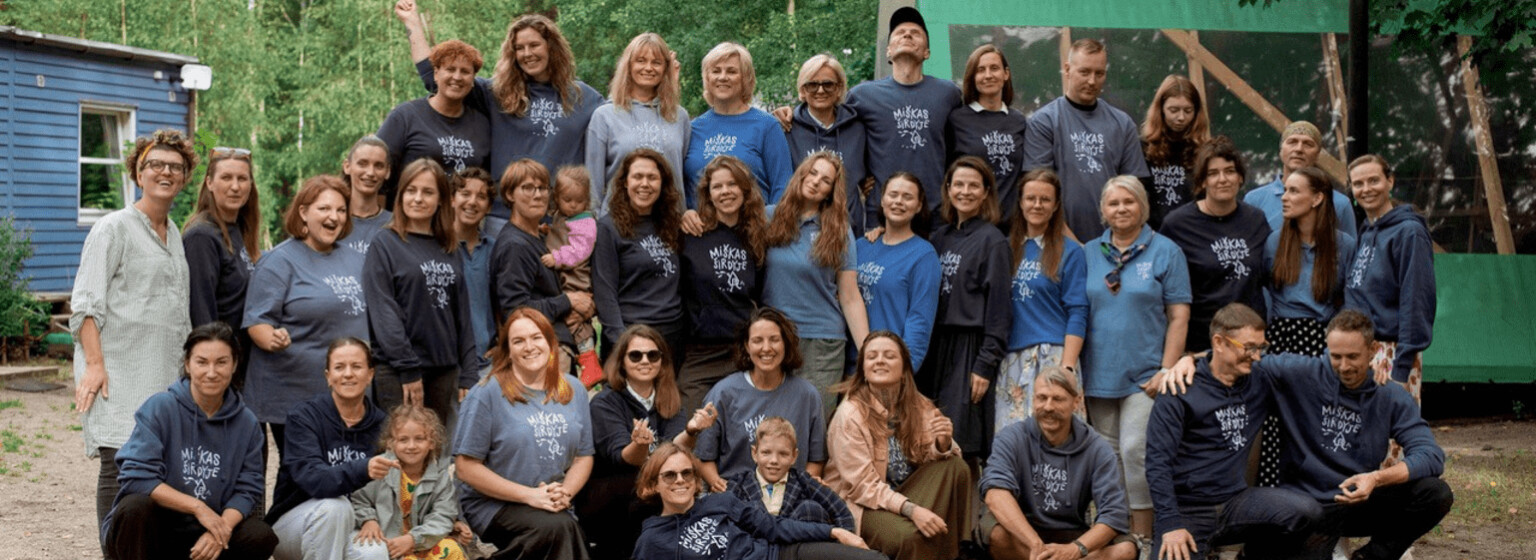
Forest School has grown from 40 to 140 children. It has developed outdoor play and learning spaces, grown into a primary school, opened its own kitchen, and become an outdoor education center providing training for Forest School teachers as well as educators from Lithuania and abroad. International job-shadowing and training opportunities have brought new methodologies and projects into the school.
“But this is just a number,” Dovilė says of the growth from 40 to 140 children. For her, the most important change has been understanding more clearly what the school stands for.
“Most importantly, we have defined what our school values are and why we are doing all the work that we do.”
Dovilė herself has grown alongside the school. Today, she describes herself as a much prouder and more confident leader, particularly as she sees the competence of her team and the impact their work has made on families in the Klaipėda region.
She is also more confident about the school's “why's” and “how's” — something that makes it easier to think about the next stage of Miško Mokykla, including middle school education, and, as Dovilė puts it, “makes it possible to dream even more.”
When Dovilė talks about what makes her most proud, she starts not with facilities, programs, or growth, but with her team.
“I am definitely proud of our team. The whole of it, starting from the cleaners to the leaders.”
She describes working with people who have a growth mindset, both personally and professionally. But alongside the serious work of education, Dovilė values the small things, the jokes, and the ability to enjoy everyday life together.
“I think it is very important to be able to learn and laugh hard.”
One of her favorite Japanese proverbs captures the atmosphere she wants to create: “Joy comes to the house where laughter is heard.” It is something she tries to live by and bring into the life of the school.
The values behind Miško Mokykla were not always formally defined. Dovilė remembers a new teacher, Emilija, joining the team seven years ago and asking her a deceptively simple question: “What are the values of the school?”
“As a leader, I was pushed to clearly have this answer,” Dovilė recalls.
Within weeks, the school had articulated the values that continue to guide it today: health, connection to nature, community building, creativity, and critical thinking. Dovilė always likes to add one more — “playfulness.”
Those values, she explains, come with respect, clear communication, and an understanding that everyone in the Forest School community — team members, children, and parents — wants “the best,” even if their ways of reaching “the best” sometimes differ.
Community is not something Dovilė believes simply happens on its own.
“Having a strong community is not very cultural for Lithuanian cities, so I believe that we all need to work towards having and building it.”
She sees community building as part of her responsibility as a leader: organizing events, talking to people, dealing with everyday challenges, and, perhaps most importantly, being honest.
For Dovilė, openness means sharing good moments but also being willing to ask for help when things become difficult.
“I feel that this is what is most difficult, but when I ask for help, I mostly receive positive answers — we, human beings, are generally very happy to help.”
Sometimes community takes shape through very simple traditions. Miško Mokykla, for example, organizes a clothing exchange. It is a sustainability initiative, but Dovilė sees something more personal in it: “What can be more exciting than seeing another mom with your beloved dress, or another child with your child's outgrown shoes?”
That openness to other people also extends beyond Lithuania.
Miško Mokykla has participated in Erasmus+ and Nordplus projects since 2018, welcomed international volunteers through the European Solidarity Corps, and participated in job-shadowing and training abroad. International families and teachers have also become part of everyday school life. But for Dovilė, calling a school international means much more than having an English-speaking teacher or several international families.
“I think the organization becomes international when it is open to different people and different mindsets, when language differences do not make boundaries to communicate, but build bridges to learn from each other and forget the fears that come with the unknown.”
As a leader, one of her goals is to make sure there are always people from other countries within the Forest School community — not only to expose children to another language, but to help them encounter different perspectives. And she is proud that this exchange works both ways. Miško Mokykla introduces international teachers and volunteers to Lithuania as well. Dovilė points with particular affection to two teachers, Peter from the UK and Mark from Belgium, who are “in love with Lithuania and Forest School.”
The international perspective that Dovilė now intentionally cultivates at Miško Mokykla has deep roots in her own LCC experience.
Asked what has stayed with her from her student years, one memory comes immediately:
“The dinners at Mininger's house… This was something so special 24 years ago for me.”
For Dovilė, those dinners at the home of then-LCC President Jim Mininger represented something bigger than a social gathering. They created a place where people could share and build friendships regardless of their role at the university.
Then there was LCC's international community.
“The international perspective, at that point of my life, opened up the whole world of different perspectives and ideas for me — from Ghana to Moldova and beyond.”
More than two decades later, echoes of those experiences can be seen in the community Dovilė is creating herself: relationships that cross roles and cultures, openness to different perspectives, and intentional opportunities for people to spend time together.
Dovilė describes leadership as “a never-ending road of learning.”
Along that road, her understanding of what it means to lead has evolved. One important realization was that leadership does not mean simply giving everyone complete freedom and authority to make decisions. Clear boundaries and clarity about how things are implemented matter.
At the same time, she strongly believes in democracy and integration. General meetings and opportunities to participate in decisions should, in her view, exist throughout the school — for students, staff, and parents.
And then there are the lessons no leadership program necessarily prepares you for.
Over the years, Dovilė has learned about everything from electrical installation to the logistics of modular buildings.
“A leader needs to be, as we say in Lithuanian, visų galų meistras — a jack of all trades.”
Asked what children need most from schools today, Dovilė comes back to relationships, opportunities for growth, and competent teachers who can recognize the individual motivation each child brings to learning.
She describes that motivation through an image rooted, appropriately, in nature:
“I strongly believe that each child has a seed of willingness to learn, and the teachers are the ones who have the water and the soil, and other special conditions for individual growth.”
Looking at education more broadly, Dovilė would like to see a stronger connection between pedagogy, psychology, and neuroscience — bringing these areas together to help learning happen at its best while also protecting teachers from burnout.
In 2026, LCC recognized Dovilė's contribution and societal impact through education by presenting her with the Distinguished Alumni Award.
For Dovilė, the recognition was also personal. Former LCC President Marlene Wall presented the award, connecting the occasion with an earlier chapter in Dovilė's life.
“It is nice to remember the roots of my career. It was great to meet some people I haven't seen for ages and some new ones.”
But the award also represented recognition of something much larger than one person's accomplishments.
“It is a great pleasure to feel that the work that Forest School does daily is seen as an important one by others.”
And what comes next? Dovilė does not offer a carefully mapped-out answer. Instead, she hopes that she and the Forest School team will retain the motivation to keep pushing themselves “out of the box, out of the comfort zone” and continue learning with one another and with the children.
If they can do that, she believes the rest will follow and the school will grow in the way that is best for the children.
She also hopes to continue finding “wisdom and generosity in simple things.”
For now, her view of learning remains wonderfully uncomplicated:
“Today, I say — and also the science! — that nature is the environment to learn, paper and pen is the best tool. Let's see what changes in another seven years.”
Seven years after LCC first shared the story of an unconventional kindergarten and the alumna behind it, that seems like an appropriate place to leave the story — for now.
And if current LCC students or young alumni are wondering what to do with an idea of their own, Dovilė's advice in fewer words is: “Just do it!”
Search LCC
Press ESC key to exit