LCC International University > News and Events > Connecting the Dots Conference Reflection
Connecting the Dots Conference Reflection
2026-11-12
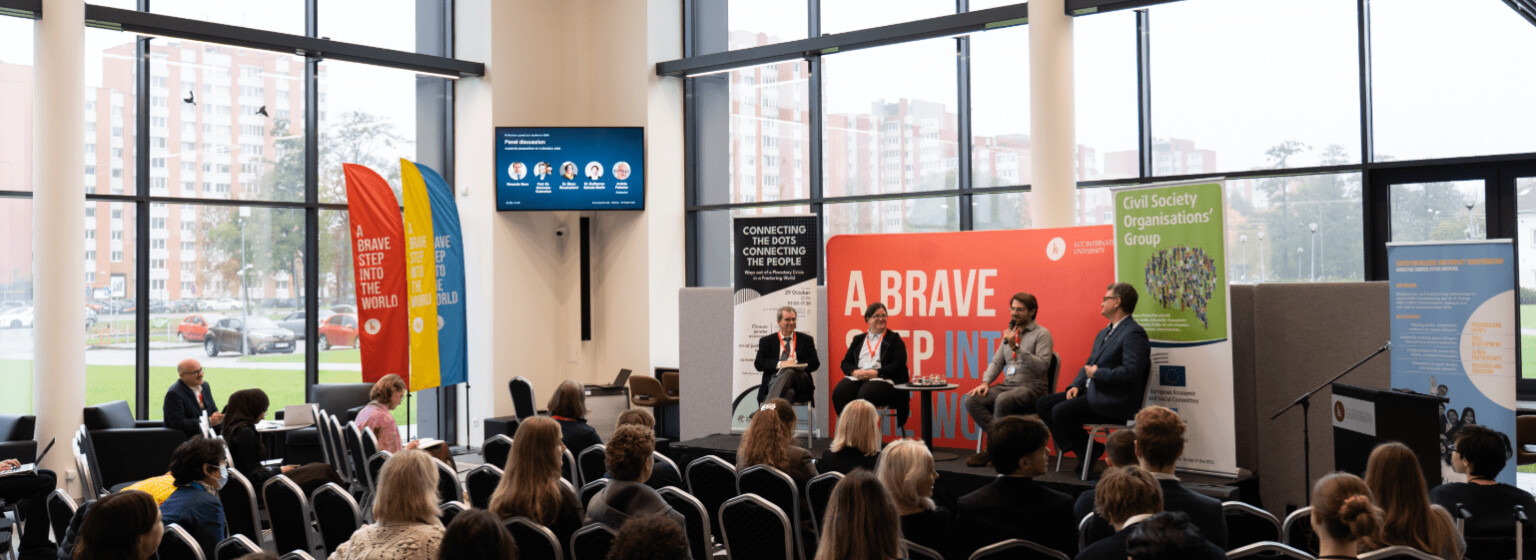
On 29 October, LCC International University hosted "Connecting the Dots, Connecting the People: Ways out of a Planetary Crisis in a Fracturing World," a full-day conference in the Learning Commons. The event brought together scholars, students, civil society representatives, public officials and international experts to ask how climate, gender, economic and social justice intersect in a world shaped by ecological stress, conflict, displacement and fragmenting trade relations. Held under the patronage of the Civil Society Organisations' Group of the European Economic and Social Committee, in anticipation of Lithuania's Presidency of the Council of the European Union in 2027, it reached full capacity before registration closed.
The day opened with welcomes from Dr. Ken Stoltzfus, President of LCC International University, Prof. Dr. Artūras Razbadauskas, Rector of Klaipėda University, and Aistė Bertulytė-Žikevičienė of the Lithuanian Ministry of Foreign Affairs. Riccardo Moro then gave the opening keynote on humanity in the face of rapid transition, and on the trends, threats and opportunities it brings for global governance and peace. Andrés Falconer moderated throughout.
The morning plenary, "Charting the Dots," offered several academic perspectives on a single question: what does a way out of crisis look like? Dr. Gregg Walker of Oregon State University spoke on why international agreements and organisations matter on the road from unjust wars to a just peace. Prof. Dr. Mintautas Gutauskas of Vilnius University explored multi-species justice in the Anthropocene, Dr. Elena Šiaudvytienė asked what the Franciscan economic tradition can offer today, and Dr. Guilherme Spinato Morlin examined the trade-offs of a just transition.
After the break, participants split into four Connecting-the-Dots Labs: "Who Pays for the Transition?", "Fragmented Trade, Shared Crises," "Displacement in a Heating World," and "Whose Story Counts?" Each lab linked a different strand of the conference theme, from gender, care and intergenerational justice to human rights across conflict, climate stress and migration, and to Global Majority voices and the politics of climate and development communication. Student voices took part in every lab, and each lab's rapporteur brought its conclusions back to the full room in the afternoon.
The afternoon began with a welcome from the European Economic and Social Committee, which spoke about how organised civil society contributes to democratic, inclusive EU decision-making. Dr. Serwah Prempeh of the Africa Policy Research Institute followed with a deep dive on re-thinking green technology diplomacy. The day then turned to two parallel policy roundtables: one on what response is needed in an increasingly complex world, from Seville to Hormuz, and one on how to protect rights, representation and agency amid conflict, displacement and global fragmentation.
Students were part of the programme from start to finish. Selected students from LCC International University and Klaipėda University shared testimonials in the afternoon, and student voices took part in each lab. Among them was Usama Habib Khan, a first-year MSc student in Regional Governance at Klaipėda University, who took part in the lab on displacement in a heating world. Asked what he would like decision-makers and other students to take away from the day, he said:
"In today's globalized world, mankind is facing complex problems. To address the complexity of these issues, we need a collaborative approach. Interorganizational networks might be one of the effective tools that decision-makers can use to solve these problems."
Connecting the Dots reminded the LCC community that peace cannot be separated from the questions of climate, economic fairness, rights and belonging that the conference put side by side. By bringing students, researchers, civil society and policymakers into one room, it offered a practical example of the collaboration that Usama described: people from different fields and countries working on shared problems together. For the Center for Dialogue and Conflict Transformation, the day was a chance to connect that conversation with the work of dialogue and peacebuilding on campus.
The conference was organised with co-funding from the European Union. The "Connecting the Dots" project is coordinated by the European Network on Debt and Development (Eurodad) under the EU's DEAR Programme, and the Lithuanian Consumers Alliance is responsible for the content of the conference. It is also co-funded by the Development Cooperation and Humanitarian Aid Fund of the Republic of Lithuania. The views expressed do not necessarily reflect those of the European Union.
Search LCC
Press ESC key to exit